
I travel a lot for work, here are some of the things that make it better. See the bottom for my list of recommended products you can go and buy.
On trips
As short as possible: I make the trips as short as possible. I fly in, do the thing, and fly out. The longer a trip lasts, the more I miss of the rest of life and work.
A full schedule: A work trip is for work. So maximize the amount of work you can specifically do in that place. I don’t leave space for hope or accidents. If I find holes in my schedule, I try to move things around to either shorten the trip or do additional things.
Never allow trips to make you feel important or productive: Work trips are for things that can really only be done well in-person or at a particular location. It’s very easy to feel important about having to travel to do your work. I think travel can lull you into a false sense of productivity. I’m on the road, therefore I’m productive. I think this is very misleading. You should be picky about whether to go on trips at all as they are massive time-sucks.
Hotels
Gym not optional: I only stay at hotels with a gym and pack so I can workout daily. If space is very limited in my packing, I bring barefeet shoes for the gym specifically, which pack very flat.
Convenience when there: I look for the hotels that are most convenient for whatever it is I’m going to be doing. Usually that means staying close to the center of where I’ll spend most of my time.
Good hotel wifi is a mirage: I don’t expect the hotel wifi to ever be good. I rely primarily on 5G. Occasionally I’m positively surprised by good wifi. But rarely.
Flights
Fast track yes please: Most airports have some sort of fast-track option. I usually fly out of Schiphol (AMS), which has a fast-track program called Privium. These are expensive for occasional travelers, but if you travel frequently they are worth their fees. Skipping lines means you can arrive (much) later to the airport. Less time on the airport is better.
Avoid airplane food: If you want to be healthy, don’t eat airplane food. It comes at a weird time, and the quality varies wildly, but the variation happens mostly on the left side of the curve. You can usually get better food at the airport before boarding, or just don’t eat. You will probably survive.
On intercontental flights sleep: Don’t fall in the trap of the schedule set by the plane. Go to sleep right away with a sleep mask (see below for a recommendation) and melatonin. Ignore whether the lights are on and whether meals are being served. You don’t want those meals anyway. Aim to sleep as much as possible, and stubbornly keep trying to sleep until 6-8 hours have passed at least. This will benefit you greatly on the other side.
Be kind to the people around you: I see so many people treating the workers at airports and in planes poorly. I try to compensate for those a little by being extra kind. It’s no effort to look someone in the eyes when you talk with them and say hello and thank you. Similarly to parents struggling with a (loud) little one. Don’t stare, don’t complain, don’t gossip. Those people are in a worse place than you are if their child is screaming the whole flight, believe me.
Never check in a bag: saves you a whole lotta time and stress. In longer trips, I take a large backpack with me in addition to the carry-on.
Dealing with timezones
There has been quite a bit of research into how to deal with time zones best. High level, if you’re traveling between two time zones that are many hours apart, your body will need about three days to acclimate to the new time zone.
I like to use this app called Timeshifter which gives specific suggestions on when to sleep and when to be in light. I found that actually it helps quite a bit with transitioning between two time zones, especially if they are more than six hours apart.
If you don’t want an app to tell you what to do: see light when the sun is supposed to be up in your new timezone. Sleep when it’s dark. Eat light meals. Workout in the morning. After three days you’ll be okay.

Staying healthy
Travelling for work tends to be unhealthy. You’re exposed to loads of people between airports and planes, and exposed to loads of poorly ventilated areas. Your sleep schedule is affected heavily and you can’t eat the foods your normally eat at the times you normally do.
That’s all fine if travel for work is occasional. But it’s not when it’s frequent. When you travel frequently, you must figure out how to stay healthy while on a trip. I do a few things that might help you too:
Be as diligent as possible around my sleep. This is super hard because a trip often demands things out of the normal schedule, but try! I also account for the fact that I’ll probably sleep worse in the place I’m staying - and try to compensate with some more time in bed
Take my supplements religiously. I take a Bryan-Johnson-amount of supplements, pre-mixed in separate doses. But even if you just take magnesium and some vitamins: don’t let the trip trip you up! A simple container to bring things goes a long way (my recommendation below)
Eat healthy whenever not in a formal dinner situation. In formal dinners, you have only limited options, but outside of that you can easily eat healthy in any big city.
Any typical restaurant food is much higher on salt and fat than you’d normally take in. That’s great, it makes the food taste better, but not very healthy. So I try to adjust all other meals accordingly.
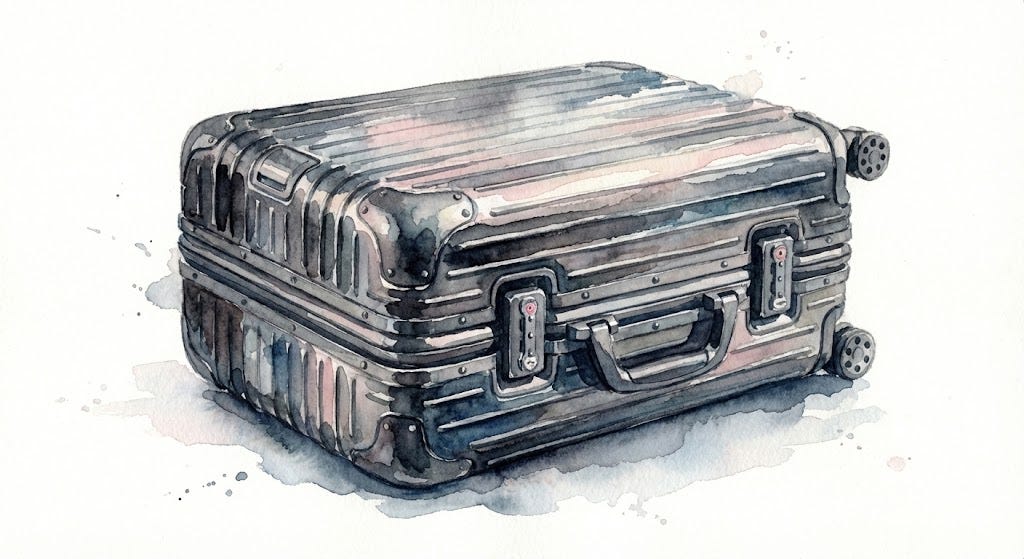
Some useful things I take on trips
Rimowa carry-on trolley € 1270 these are ridiculously expensive and I can’t recommend them in honest because of that, however the alumimium lasts really well. You can also get it fixed anywhere in the world within warranty (although I never had to). I love how the black one gets all scratched. I’ve used it on 100+ trips and never had any issues with it.
Manta original sleep mask $39 I’ve tried a whole bunch of sleep masks. I really disliked they pressed against my eyes. This one doesn’t have that, and I’ve used it on every intercontinential flight I took the last four years.
Alpine Flyfit earplugs $17 I have a lot of pairs of these. They are small and comfortable and allow you to lay on your side without your ears hurting if you try to sleep in the plane. I much prefer them over other brands.
MacBook Air $999 I have a base spec MacBook Air just for travel. When I’m on the road for work, I rarely to intensify work - and I can always do that through a remote terminal if I really need to. So I get to choose for weight instead. The base model, 13-inch MacBook Air is really light. It does have one very massive downside compared to the Macbook Pro and that is the lack of a HDMI port. If you present a lot in conference rooms, I’d get a Pro just for that.
Aer Travel Pack 3 €310,00 This is the big backpack that I take for longer trips. It fits everything and is built very seriously.
Aer Pro Pack Slim €155,00 My default backpack that I take most trips. It’s small and simple, has a laptop pocket and one for a water bottle. All one needs.
A packable GORE-TEX rain jacket $450 I have an older model of this, but it’s a very packable, ultra-light rain jacket. It’s always in the bottom of my backpack. It’s too tight to go over another jacket, but fine over a sweater. In most trips I just use this as layer over a sweater and that suffices for most climates and in-and-out of office buildings. For trips where I’d spend more time outside, I’d pack something more, but business trips are usually not that.
A packable down jacket $400 This is my most recent addition. For trips into colder climates where I really do have to take a jacket (I generally avoid taking one), this one does really really well. I’m in love with how well this thing is made.
Vivo Barefeet training shoes ~$120 I’m not a barefeet fanatic, but I got these specifically because they pack very flat. I only use them in the gym
Airpods Pro 3 $250 Although I have a very fancy home setup for video calling, on the road I just use the Airpods. They are reliable and can be easily used both in noisy and other environments.
Blender Bottle Go Stak supplement containers $16 I take a bunch of supplements and during travel especially I worry about making sure I keep up. These bottles are small and screw onto each other easily. I put my supplement powders directly in, which makes me feel like I’m smuggling something, but I never had issues at the airport for my strange powders.
Melatonin pills $10 take a pill an hour before sleeping when travelling between timezones. Low dosage (3mg) works better for everyone.
Satechi 145W USB-C Travel charger $120 This is the only charger I take on a trip. It’s heavy and chargers everything fast. Besides it, I take a a couple of usb-c cables and I’m done! I now have three or four at home, because it’s so useful to have a fast charger with 4 ports. Highly recommended.
A kindle or sometimes a Nintendo Switch 2. Reading is the best way to spend time on planes other than sleeping. Playing games a helpful distraction.
Notably absent
I don’t take external phone batteries anymore since switching to the Pro Max iPhones. The batteries last forever. Similarly, with ample options for e-sim, it’s now become a total non-issue virtually anywhere to get loads of high speed mobile data. Just open Airalo or one of the others to quickly get a local e-sim for little money.
In the past I’ve carried more items to make myself feel more productive. Like an external keyboard, an Apple Vision Pro, or better mic/camera. I’ve found that this is not worth the added bulk and packing for me (especially the Apple Vision Pro, which is a behemoth).
The only thing I don’t take that I feel sad about is one of my cameras. I have a lot of great cameras (future post..), but the extra weight and frustration of not really being able to use them makes me not take them.
On food and sleep during flights: I've found the same thing. Meals just before sleep impact the sleep quality, and the airplane food is rarely worth it anyways.
On short trips: hotel gyms can be hit or miss. Instead, I've started packing running shoes and aligning those travel days with cardio days. It's nice getting some fresh air, and connecting a little with the place visiting.
Nice write up! What's the prompt/model for the images? I like em