
I have been fortunate to grow up with Google for most of my life, and so it always seemed very obvious to me that you can really teach yourself anything. What is the purpose of education?
But truth be told, Googling is a skill. You need to figure out how to search for things and be able to evaluate the validity of the contents.
I was brought up with the idea that you couldn’t use Wikipedia as a source. And so, there was still value in education, in the raw materials that education would bring to you because they were carefully put together. They helped you build knowledge upon knowledge upon knowledge so that you become somebody that knows something.
But that time has passed. You don’t need to learn to Google anything anymore. You can now ask an AI for anything, and you will get a mostly, if not entirely, accurate answer. More than ever before, you’re now able to ask clarifying questions until you understand.
This is one of the greatest changes in learning and education that has ever happened. Up until now, if you wanted to learn, let’s say, about neuroscience, there was a point at which you would either have to dig into books and books and books to figure to form an intuitive understanding of particular systems in the brain. You would have to find a teacher that could answer your questions no matter how silly or complex, just because the way the information was presented in books didn’t necessarily match how your brain organized the information.
But now you have the world’s greatest teacher at hand at all times. You can ask an AI to teach you about neuroscience, and then you can ask it to teach you in a way that suits you, and you can keep asking questions.
AI is endlessly patient. It will keep answering your questions for as long as you keep asking them, and with each passing month, the AI is getting smarter and better at doing this as well.
Today you have the world’s best, most patient teacher available to you at any point in time. And these are teachers that know at least the basics of almost anything and can teach them to almost anybody at any time.
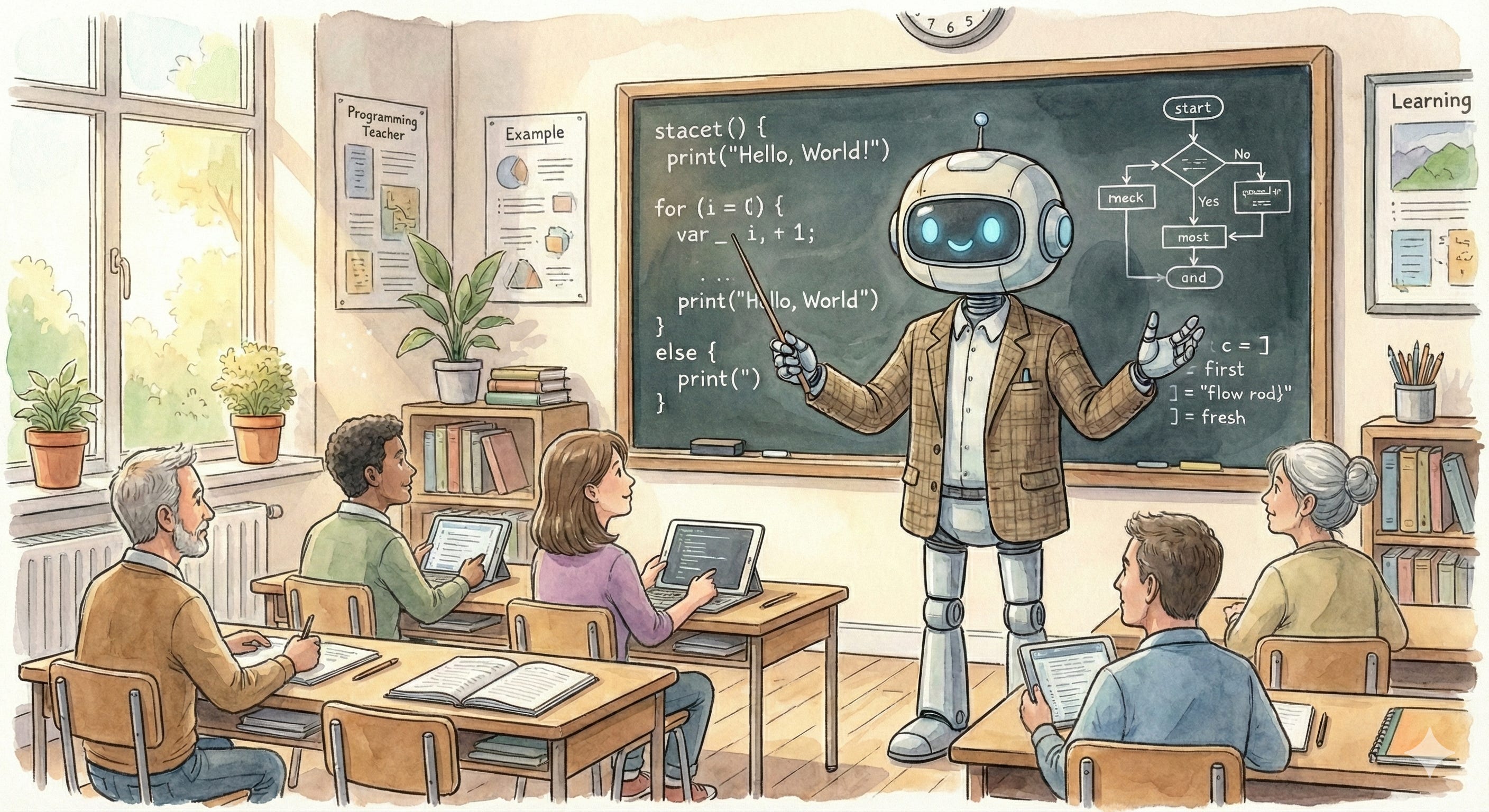
Everything always at hand
Thus, the time to have an excuse of not knowing something has passed. Sure, you might not know something. In fact, you’ll probably not know lots of things. But teaching yourself something new has become easier than ever before.
Certainly, some things are hard to understand and will take you lots of time and study, even with AI, to truly grok. But access to that is available to everybody.
My personal pet peeve is when people call themselves non-technical. Essentially what you’re saying is that, hey, I’m good at lots of things, I just can’t program.
That time has passed too! If you want to learn to program—and really, I shouldn’t have to tell you this—you already know what to do. You simply ask AI “hey, teach me how to program. Where do I get started?” You can keep asking clarifying questions until the very point that you deeply understand it. And you can go as deep as you want.
Now the burden of knowing is on you and nothing else.
Experience and depth still count
Now there are some limitations to this. The first one being experience. There’s still inherent value to experience. Not all human experience is encoded in the AI, and so AI is not be able to share that necessarily with you. At the same time, it’s not possible for you to learn everything all at once and instantly grok all of it. You will still have to spend time, flexing your brain.
Yes, you will still need to study, and studying takes time, and learning things takes time. But, for the betterment of your life or work, there are not a lot of excuses anymore to not know something.
Companies are now changing faster than ever before. It’s up to you to change along and gain the skills and knowledge to keep up.
If you make time for learning, which I realize is a big if, then there really shouldn’t be a reason for you to not become technical, to not grow along with the company and have the knowledge to thrive in this day and age.
Super interesting article, Job. I'd love to know your thoughts on EdTech, books vs screen learning, and how we should view the "world's greatest teacher" when it comes to our children....
I watched it happen in real time. Between 2005 and 2008, something shifted in classrooms that has never shifted back.
Facebook arrived. Then video social media. Then the dopamine-optimized content machine that now defines how an entire generation processes information.
Schools have been fighting a war for attention ever since. And they're losing badly.
The evidence is everywhere. 77% of U.S. public schools now prohibit cellphone use during class. Between 2024 and 2025, almost two-thirds of U.S. states adopted policies to restrict phones during the school day. The only way schools can get students to pay attention is to physically remove the competition from the room.
Two generations ago, schools were a nice-to-have, not a necessity. You could wash dishes, start a restaurant, and build a comfortable life without formal education. You could farm. You could work with your hands. You could create financial security through trade skills and entrepreneurship without ever stepping into a university.
But by the late 20th century, something fundamental changed. Schools and universities exploded in popularity because knowledge work became the primary path to a comfortable life. For Millennials and the generations that followed, education became mandatory - the clearest and often only route to economic security. That's still largely true today.
Schools became central to society because they delivered on a clear promise: acquire knowledge and credentials, land a knowledge work job, live comfortably. And for decades, schools were successful because they prepared students for exactly that kind of work.
But here's what's breaking: knowledge work itself has fundamentally changed, especially for Gen Z entering the workforce now.
Modern knowledge work is less about the knowledge part and more about long-term horizon goals, complex problem-solving, and - crucially - the ability to focus without being distracted by procrastination.
The classroom model still looks like it did before the internet. Stand at the front. Deliver information. Test recall. Repeat.
But we live in a world where knowledge is commoditized. You can learn anything from anyone at any time for free. The entire educational model is built around providing knowledge in an era where knowledge is the least scarce resource we have.
Schools are still optimized for knowledge transfer and recall - the skills that mattered when education became mandatory. Meanwhile, the skills that actually matter now go undertaught: sustaining focus on long-horizon tasks, tech savviness, strategic problem-solving, and soft skills. We're building students for the last century's version of knowledge work while the current version demands something completely different.
Students know this. They feel it.
That's why they reach for their phones.
Here's the uncomfortable truth I don't hear people saying out loud: AI has created a credibility crisis in education.
Why would a student trust a teacher who knows less than the device in their pocket?
AI knows more than teachers on basically every topic taught at undergraduate level or lower. It can explain concepts countless times at any level. It answers every question without splitting attention across a classroom of 30 students. It never gets tired, never gets frustrated, and it's available at 3 AM before an exam.
The data backs this up. A 2025 randomized controlled trial found that students using AI tutors performed substantially better than those in traditional active learning classrooms. We're talking effect sizes of 0.73 to 1.3 standard deviations - one of the largest effect sizes ever recorded in education research.
Students who actively engaged with AI tutors achieved up to 15 percentile points higher grades compared to parallel courses without AI support.
The machines are already better at the core function we built schools to perform.
What AI Already Does Better
AI tutors offer something no human teacher has ever been able to deliver at scale: true personalization.
They provide adaptive learning pathways. Real-time feedback. Tailored content that adjusts to each student's grasp of concepts. Unlimited patience and availability. No judgment when you ask the "stupid question" for the fifth time.
A 2025 global systematic review found AI consistently outperforms traditional methods when measuring learning effectiveness. The evidence base is no longer debatable.
Right now, AI tutors have two critical gaps that prevent them from completely replacing traditional education.
First: persistent memory.
Current AI tutors forget. They can't track a student's journey across sessions, across a semester, across an entire academic career. They can't build on what you learned last week or identify patterns in how you think.
When AI gets persistent memory, it unlocks personalization beyond a single session. Personalization over a semester. Over a degree. Over your entire learning life.
Second: curriculum coherence.
AI tutors today can't follow a curriculum consistently. They forget where they are. They skip content. They don't present information in a logical scaffolding order.
A curriculum isn't just a list of topics. It's a carefully sequenced presentation of information that builds understanding step by step. AI tutors can't maintain that coherence yet.
But they will.
And when they do - when AI can both remember your entire learning journey AND maintain logical scaffolding while adapting in real-time - that's when the tsunami hits.
By 2027, we'll have AI tutors that are personalized, adaptive, guided, low-cost, and always available. They'll remember everything about how you learn. They'll follow coherent curricula while diagnosing emerging gaps and addressing them in real-time.
The same thing that happened to chess players after Deep Blue. The same thing that happened to local theaters after Hollywood. The same thing that's happening right now to software engineers.