
Your best chance is to join a startup as one of the very first employees. At that stage you have a ~1% chance of earning a million dollar cash after tax. Switching startups to favor earlier positions after a cliff, but before fully vesting is only worth it if the next startup has a higher likelihood of success. Even then, after 12 years and consistently being hire ~1-5, the chance you earn a million in an exit is maybe 3%.
However, the chance that a low-risk job will give you a million dollar exit is 0%.
Startups usually fail
It is well known that most startups fail, which is also one of the great reasons why it’s fun to join a startup because you’re trying to do something that is high risk and potentially high reward. But regardless, it is a journey, often a journey of consecutive failures.
75% of all venture capital (VC) backed startups never return any money to investors, let alone employees.
A startup fails when it runs out of money or for other reasons has to shut down. Now, this can happen in the first year or in the tenth year of a startup, and it still continues to happen with companies even after they have gone public and make hundreds of millions of dollars in revenue.
Saying that a startup is going to fail is in itself an obvious statement. But the reality is that most startups fail after a short period of time, even after raising millions of dollars of revenue, because startups hit particular walls. They might not be able to scale beyond a certain point. They might hit regulatory problems, or in many cases, startups fail because the co-founders and/or the board get into an argument which ultimately brings down the company.
Startups fail most of the time. But sometimes they don’t, and when they don’t they tend to make a few people wealthy.
What determines whether you get rich
To get rich in a startup you have to be able to sell your shares. Enough of them and at high enough a price that you make a serious amount of money (>=$1 million for this exercise).
The number of options you have
The earlier you join a startup, the more shares (usually options) you get in a startup. The first employee tends to get 1-10%, the second a bit less, and so on. This is fair, because the first employee takes significantly more risk (there is no real business yet) than later employees.
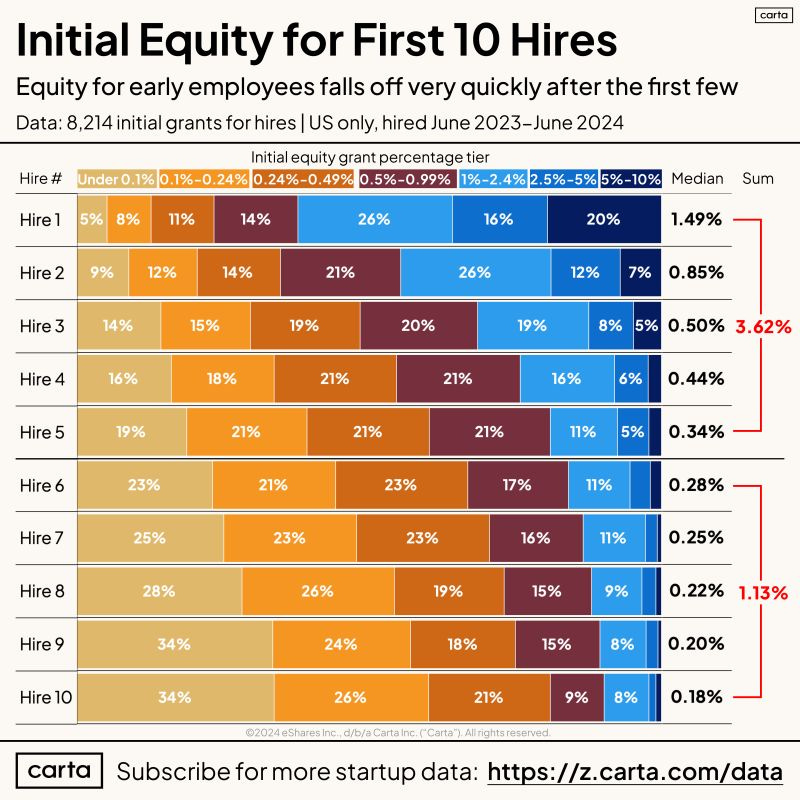
Another advantage early employees have is that their options have a very low exercise price (usually nearly zero) - the price to make from the option a share. The later you join, the more likely the exercise price is higher, which ultimately is substracted from your total potential profit on any given share, given you have to pay for exercise first.
Dilution
Your first option grant is usually represented in number of shares, and can be calculated as a % of the total ownership of the company. So if there are 1000 shares, and you get 10 options in the company, your ownership is 1% (after you’d exercise them, that is).
However, as the company raises new rounds of funding or issues more options the total number of shares increases. You still own 10 options, but after a few rounds of funding the company might now have 2000 shares. You now own 0.5% of the company.
This means that if a company sells for $100 million you at best get $500k. And from this you have to substract the price of exercise.
Liquidation preferences
Now the company might sell for $100 million, but investors usually have a liquidation preference. This is a clause that investors use that says “If there is an exit, we get paid our investment back first”. I could write an entire article on this, but for you what is important to know is that investors get paid first, and in some companies, they get paid first their investment twice (a 2x liquidation preference). 1
So if investors invested $50 million in a company and the company exists for $100 million, the investors get their $50 million or the equivalent to their ownership back first, before all employees and founders get netted anything.
Good investors use 1x liquidation preference that is non-participating. That means they get their money back first (the larger of their initial investment or their share ownership) and everyone else gets their % share over the total amount. Certainly other terms exist (investors have incredible leverage and information advantage here, and don’t shy away from using that) that result is far worse outcomes for everyone but the investor.
In short: even a good exit can mean that founders and employees walk away with nothing. However, amazing exits of amazingly growing companies usually are so far beyond the terms - and those companies in their growth could usually negotiate better terms as well - that everyone is happy.
The startup having an exit
Most startups fail, but not all! When a startup has an exit the shares either becomes shares of another company, become cash, become publicly tradeable or some mix of those options.
Take into account below that any projections we make around exit value for a shareholder might still be affected by investor terms like liquidation prefrences.
Most exits: 90% of exits are acquihire-like exits (<$50 million). That is: the company is acquired by another company. An employee that owns 0.5% walks away with $200k in value (pre-tax, pre-exercise) in a $40 million acquisition.
$100-500mm exit: in ~2-3% of exits of VC backed startups they exit in this range. A great success by any measure. Owning 0.5% at this stage nets you 500k-$2.5mm! Even after tax and exercise, you are probably still a millionaire if you own that much at an acquisition of at least $250mm. Depending on dilution and investor terms, the first ~10 employees are going to walk away rich.
$.5-$1b exit: ~0.5-1% of exits reach nearly a billion dollars. Same math as before. Now the 10-50 first employees are likely walking away with significant money. Employees that have joined the company later on are not sad either, but unlikely to be millionaires
$1b and beyond: Rare to see statistically at <1% (but we all know about these companies from the news), but this is where IPOs start. Companies exiting at a value of a billion dollar and beyond will most certainly create a class of new millionaires in the top 50 or 100 of employees with most equity.
At an exit, it’s rarely instant cash. When you get acquired by a private company, you just gain new shares. When a company IPOs, the shares you own are in lockup until 6 months after IPO - the share price might still drop and your value half (for a recent example, see Figma’s IPO that peaked shortly on IPO day and dipped significantly afterwards).
The devil is in the details, but if you own a large number of shares in a company that exits at a high value, you’re probably going to be okay financially.
A combined model
If you take into account later employees get much smaller grants, the fact that later stage companies are more likely to exit large (yet those two lines don’t run in parallel), the exit price being higher and most exits being less than a slam dunk you can roughly state that:
To earn at least a million through a startup exit you need to join it as early as possible and beat all the odds subsequently. If you’re 1-5th employee, your chance is somewhere between 2-5%. Beyond that, chances drop significantly, even if the company is more likely to have a larger exit.
Becoming the exception
This entire analysis assumes that joining a startup is a random draw. And you can argue that it is. However, there are certainly ways to improve your own odds. Startups with repeat founders, startups with well-known investors, and startups with strong momentum (lots of customers that stay) are likely going to be more successful than those that don’t have those properties. But finding those early enough is hard (ask any VC) and then being able to join them equally so.
If you leave a startup when it fails to take off initially, you might also increase your chances. But that only works if you consistently are able to join as first-fifth employee. Otherwise it’s probably worth vesting more options at your currently place (in case it takes off anyway).
Better chances
People that do great work tend to get rewarded highly for that. If you do extremely well at your job at any company, you will earn more money. I’ve known many sales people that have earned >$1mm over their four years at a startup. Cash.
Likewise, startups give you a lot of chances to grow in your carreer. Faster to the top, so to say. And with that, higher comp (in cash and equity). Executives at large startups tend to get paid pretty well in cash and very well in equity.
Of course, you can always start your own startup. Statistics predict the chance that any given startup fails but that doesn’t mean that you will. You might work just a bit harder, a bit smarter, and a bit more wise with you spending.
Statistics speak to the population, not to you.
I think anything above 1x liq pref is predatory, but it does happen
Two things I've learned:
(1) A 'perfect run' doesn't guarantee the big exit. As an employee, you can't control market timing or readiness for exits. You need deeper reasons to be on the startup journey beyond the payout, enjoying the ride really matters imo.
(2) "Startups are not a random draw," but the clearest signals come from being inside. If things look better from the outside than they feel on the inside, you can re-evaluate. It's up to you to decide if you're jumping ship in month 2, or year 5. You have agency.